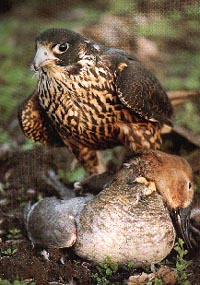
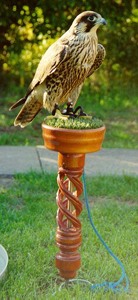
There are two ways of clocking the falcons sight one by a head cap and the other is by suturing the lower eye lid to the upper and tie it around the head. With the head cap, it makes feeding a hassle because it limits its movement and caution should be taken with suturing so as not damage the eye. Rubbing gently the falcons' chest is done to calm and help tame it. If in case it bites its owner, a hard object is given for it to bite on. While taping the back is a sign for it to let go of the pray. Its not preferred to stare the falcon because it frightens it, talking to it is encouraged so it will be familiar with the owners' voice
The falcon is taught to eat on the trainer's command with the head cap on and if refuses pressing down on its leg triggers a biting reaction. The next stage is to train it without the head cap, which is removed slowly so as not to scare it and get used on putting it back again. Jumping up to the bate and down on the bate is practiced. The final phase is to chase the rotating dummy that the falcon has to catch while being rotated around by the trainer. The dummy is a group of partridge feathers tied together.
Taming the adult is harder than the youngster and should not be hasengly trusted. Falcons shouldn't be left without a head cap in the morning; it's the birds instinct to fly off in search of food, at noon; birds will be soaring in the sky and its instinct to fly off, at sunset; it's the time for birds to head home. It's preferred to practice around people so it will get used to humans around. To prevent injury it is important to have the Handler glove that can be traced back to Chosrose Ano Sharoan. go to my hunting page